From Charging Infrastructure to Charging Trust
Europe has spent the last decade solving one problem: Where should EV chargers be installed?
The next decade will be defined by a different question:
What happens when the driver arrives?
The evolution of the EV market follows a familiar pattern seen in many technology transitions. Everett Rogers’ Innovation Adoption Curve explains how new technologies move from innovators and early adopters into the mainstream market, with each group bringing different expectations and behaviours.
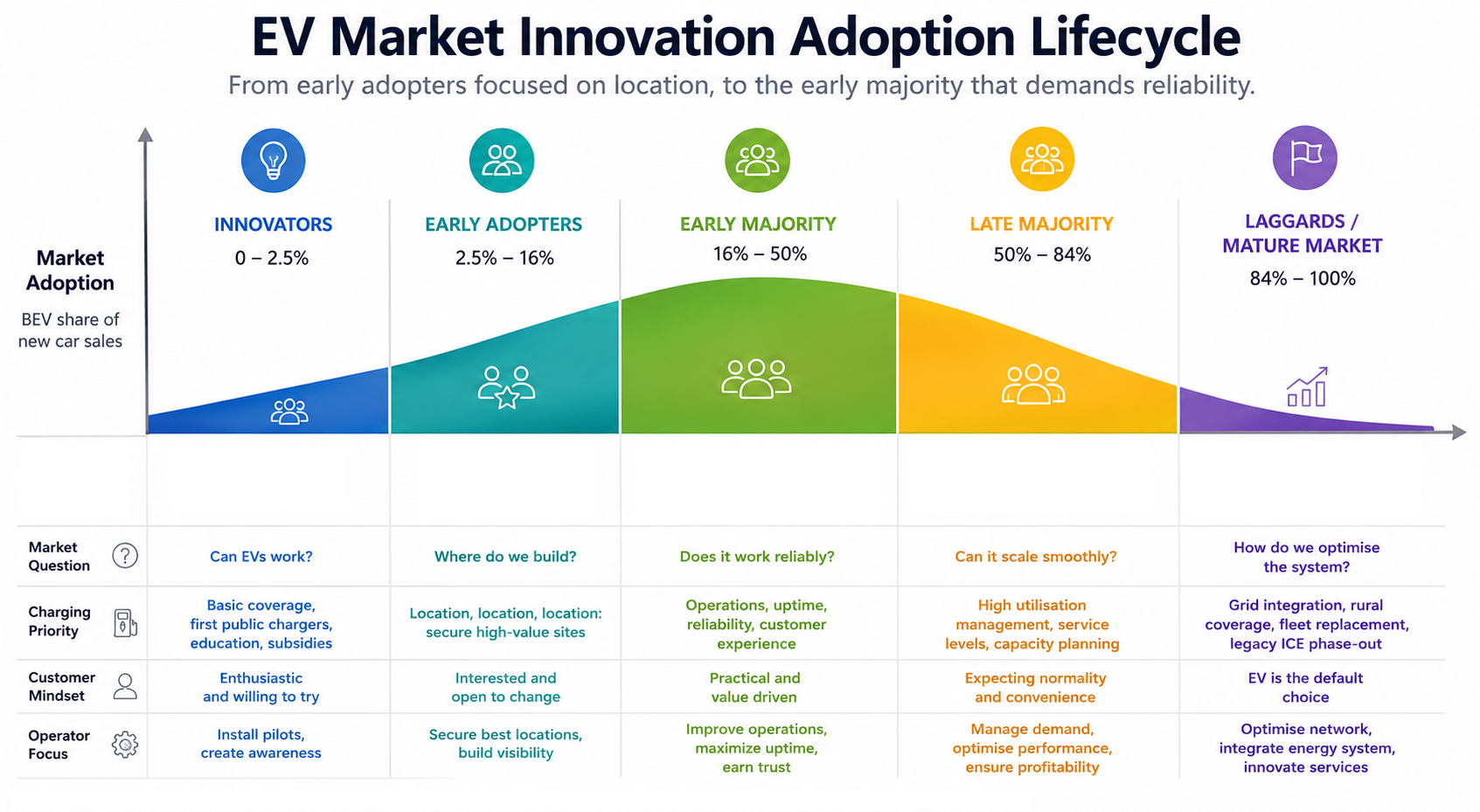
As EV adoption moves beyond enthusiasts and early adopters, the competitive advantage is shifting away from coverage and toward operational performance. The networks that win won’t necessarily be those with the most chargers. They’ll be the ones driver’s trust.
Trust is becoming a commercial asset. Porsche Consulting’s 2025 Usability Index found that 44% of EV drivers avoid a charge point operator after a single poor charging experience. As the market moves into the early majority phase, operators will increasingly compete not just on coverage, but on confidence.
For much of the industry’s growth, the priority was clear. Governments, charge point operators (CPOs), fuel retailers, municipalities, and site owners focused on building coverage and securing strategic locations. Motorways, retail parks, fuel stations, city centers, workplaces, hotels and fleet depots all became part of a race to establish charging infrastructure where drivers needed it most.
That focus was both necessary and successful. A visible and accessible charging network was essential to supporting the transition to electric mobility. Drivers needed confidence that they could find a charger along their route, near their home, at work or at the destinations they visited every day.
In many parts of Europe, that challenge is now being addressed and the market is entering a new phase.
As EV adoption continues to grow, particularly among mainstream consumers and commercial fleets, the conversation is beginning to change. The question is no longer simply whether a charger exists at a particular location. It is whether that charger is available, reliable, safe and easy to use when the customer needs it.
An installed charger does not automatically create a positive charging experience. A charger that appears online in an app but fails to start a session does not create trust. A charging bay blocked by another vehicle, a damaged connector, a failed payment terminal or a poorly maintained site can all turn a theoretically available charger into an unavailable one.
For the next wave of EV drivers, these distinctions matter.
The Early Majority Has Different Expectations
Innovators and early adopters are typically willing to tolerate friction. They are motivated by the technology itself and often accept a degree of inconvenience while a market matures. They are prepared to test different charging networks, use multiple apps and work around operational shortcomings.
However, the early majority behave differently.
This group includes families, commuters, company car drivers, taxi operators, delivery fleets, apartment residents and business travellers. They are not interested in becoming charging experts. They simply expect charging to work.
This transition is already underway. While battery electric vehicles account for approximately 2.3% of the total passenger car fleet across the EU, EV adoption is significantly more advanced in markets such as the Netherlands, Belgium, France, Germany, the UK and much of the Nordic region. In these countries, EV ownership is increasingly moving beyond early enthusiasts and becoming part of everyday mobility.
As adoption broadens, customer expectations inevitably change.
Drivers do not want to figure out which app to use. They do not want uncertainty about whether a charger is operational. They do not want to arrive at a location and discover that a charger appears available on a network map but cannot successfully deliver a charging session.
For the early majority, EV charging is not an experiment. It is simply another essential mobility service.
That shift in expectations changes the competitive landscape.
The challenge is no longer just building charging infrastructure. It is delivering a charging experience that customers can depend on every time they arrive.
From Deployment to Performance
For years, success in EV charging has largely been measured by growth.
- How many chargers have been installed?
- How many locations have been secured?
- How much geographic coverage has been achieved?
These metrics remain important. Significant infrastructure investment is still needed across Europe, particularly in regions where charging availability remains limited. But infrastructure alone is no longer enough.
As utilisation increases and the customer base broadens, operational performance becomes a critical differentiator. Drivers do not evaluate charging networks based on deployment statistics. They evaluate them based on real-world experiences.
The charger either works or it doesn’t. The payment process is seamless or it is not. The site feels safe and well maintained or it does not.
Every charging session contributes to customer trust – or can erode it.
Uptime Is Not Just a Technical Metric
One of the most important shifts the industry must make is how it thinks about uptime.
Traditionally, uptime has been measured from a technical perspective. If the charger is connected, communicating and reporting normally to a back-office system, it can be considered operational.
The industry’s definition of uptime and the customer’s definition of uptime are often very different.
From a driver’s perspective, the cause of the problem is largely irrelevant. A charging bay blocked by an ICE vehicle, a damaged connector, a failed payment terminal or a charger that appears online but cannot start a session all lead to the same outcome: the driver cannot charge their vehicle.
Recent industry research highlights just how significant the gap between industry uptime metrics and customer experiences can be. ChargerHelp’s 2025 EV Charging Reliability Report found that while reported charger uptime ranged from 98.7% to 99.9%, only 71% of charging attempts were successfully completed on the first attempt. More than one-third of charging failures occurred on chargers that appeared operational, demonstrating that technical availability does not always translate into a successful customer experience.
As the market matures, customer uptime will matter more than technical uptime.
The question is not whether the charger is online. The question is whether the driver can successfully charge their vehicle.
Reliability Extends Beyond the Charger
The charging experience begins before the charging session starts. When a driver arrives at a location, they immediately assess the environment around them. Lighting, cleanliness, signage, accessibility and overall site condition all influence confidence. This is particularly important because charging creates dwell time.
A clean, well-lit and well-maintained charging location reinforces trust.
Poor lighting, damaged equipment, unclear signage or neglected surroundings undermine it.
The charger is part of the product. The location is part of the product too.
Building an Operational Mindset
The operators that will perform best in the next phase of market growth are already investing in operational excellence today.
That means looking beyond deployment and focusing on the ongoing quality of every charging location.
Technical monitoring remains essential, but it must be supported by proactive maintenance, regular site inspections, fast issue resolution and clear accountability across all stakeholders involved in delivering the charging experience. Many of the issues that damage customer confidence are not major technical failures. They are small operational problems that remain unresolved for too long:
-Damaged cables.
-Poor bay markings.
-Broken screens.
-Payment failures.
-Inaccurate status information.
-Blocked charging spaces.
Individually, these issues may appear minor. Collectively, they shape how customers perceive an entire network.
Operational excellence is no longer simply a maintenance function.
It is becoming a competitive advantage.
From Charging Infrastructure to Charging Trust
Europe has spent the last decade building charging infrastructure. The next decade will be about building trust.
Coverage will continue to matter. New charging locations will continue to be deployed. Infrastructure investment remains essential.
But as EV adoption moves into the mainstream, customers will increasingly judge charging networks based on reliability, consistency and confidence.
They will remember the locations that worked. They will remember the networks that delivered a predictable experience and they will return to the operators they trust.
The real battle will not be about who installs the most chargers. It will be about who delivers the most dependable charging experience. Because in the next phase of EV charging, the winner will not be the network with the biggest footprint on the map. It will be the network that drivers trust when they arrive.